
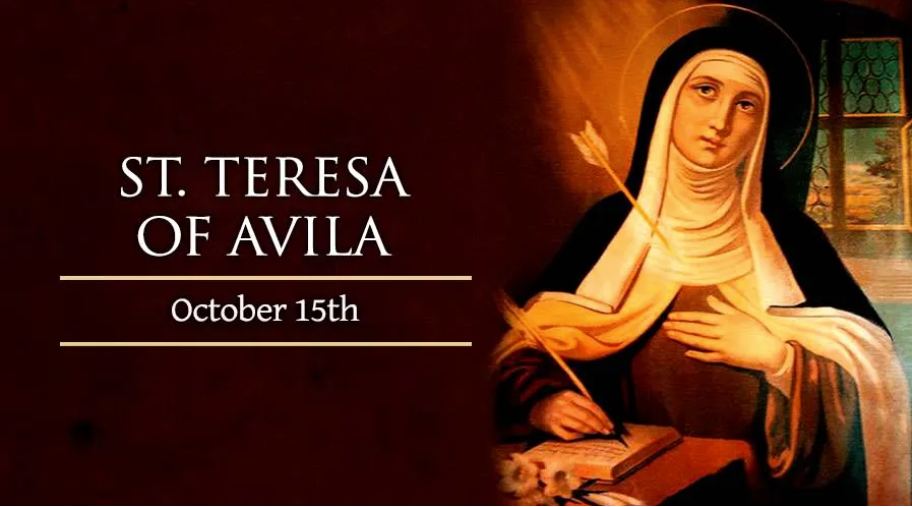
We celebrate the feast of St. Teresa of Avila on October 15, a Doctor of the Church. Describing her can be challenging because of her depth and complexity. Many of you may already be familiar with her remarkable life and spirituality. If I had to sum her up briefly: she was a contemplative who accomplished a great deal. Teresa was a mystic deeply grounded in reality. Who else would have said: “There is a time for penance and a time for partridge”? She was both gentle and compassionate, yet unflinchingly tough, never hesitating to speak truth to power. Although she followed orders, even when they were meant to restrict her, she refused to be confined.
Teresa came from minor nobility; her father was a strict knight who sought to marry her off. When her mother died at 15, Teresa entered a convent a year later—partly because her father found her difficult to manage. It took her time to discover her true vocation, and after many years she was called to reform her community. At that time, many convents had become social centers for upper-class women who couldn’t marry, raising money through hosting gatherings. Teresa envisioned a different path, desiring her community to focus on prayer and poverty. Despite considerable resistance, and even being summoned before the Inquisition, she persevered.
Teresa was a resilient woman, spiritually and practically. She is said to have experienced such deep states of ecstatic meditation that she would levitate, and she asked her sisters to hold her down so she wouldn’t float away. Not only did she initiate reforms within her own Carmelite community, but she also helped reform the Carmelite men’s order with the assistance of St. John of the Cross, who was recently recognized as a Doctor of the Church.
One of Teresa’s profound reflections was: “The tree that is beside the running water is fresher and gives more fruit.” She understood that Christ is the source of all life, and she lived this belief fully. He equips them to carry on His mission, teaching them that the value of their time with Him will bear fruit as they go forth to live and spread the Gospel.
For St. Teresa, the fruit of contemplation was seen in one’s actions. She famously said: “God gave us faculties for our use; each of them will receive its proper reward. Do not let us try to charm them to sleep, but allow them to do their work until divinely called to something higher.” She spent hours in stillness and prayer, yet that quiet time bore significant fruit—leading her to write books, establish new religious communities, and inspire, among other things, Avila University.
We are called to live out our faith as she did: to reflect on Christ’s love and mercy and to share that love with the world. St. Teresa’s words challenge us: “Always think of yourself as everyone’s servant; look for Christ our Lord in everyone and have respect and reverence for them all.” This is a call to reconciliation, service, and justice.
4o
Please pray for all those who have died recently:
Thomas Mani (87), George Kakkassery (75) Thomas Chummar (81) P V Varghese Punnackapadavil (88) Marykutty Mathew (76)
Commemorate the Death Anniversaries of Our Loved Ones:
Prof.Baby Varghese Menacherry (61)2001.